

Halston Horizon Dark Skies: Your Go to Market Strategy
Space is a hard market to crack. The buying cycles are long, the stakeholders are numerous and knowing where to start can stop a good business before it’s out of the gate.
That’s why we ran our second Dark Skies webinar, part of the Halston Horizon series, bringing three people who live and breathe this sector onto one panel to talk go-to-market strategy properly. It follows on from our work in aerospace marketing more broadly, where many of the same principles around credibility and positioning apply.
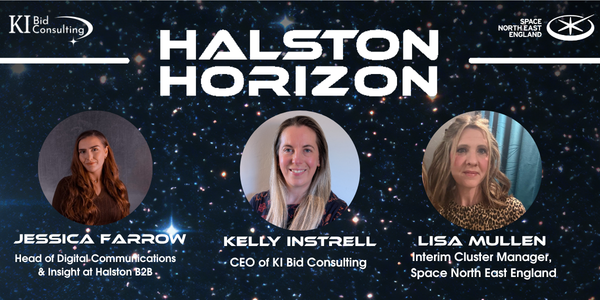
Hosted by Georgia Halston, the session ran as a live discussion with Lisa Mullen, Kelly Instrell, and Jessica Farrow, each tackling the sector from a different angle: regional cluster support, institutional bidding, and brand positioning.
Attendees asked questions throughout, with a dedicated Q&A at the end to put those straight to the panel. It’s the format we love running: real expertise, no fluff, and space for the audience to steer things where they need them to go.
Experience ≠ Credibility
Lisa Mullen, Cluster Manager at Space North East England, opened by challenging a common assumption: that credibility depends on prior space experience. Her cluster now supports around 81 companies across the region, with particular strength in earth observation and resilient communications. Filtronic, a business that pivoted from telecoms into major space contracts, was her go-to example of how existing capability transfers directly into the sector.
Her advice was refreshingly grounded. Understand where your capability fits within the space value chain, and engage properly with the wider ecosystem, from universities through to primes. Clusters exist to shorten that journey.
One story stuck with the room: two one-person businesses met through her cluster’s monthly networking event and went on to win a joint ESA bid worth close to €500,000. Neither would have found the other without it.
Her advice for a business unsure where to start was simple. Stop thinking about getting into space, and start identifying which existing capability could solve a problem the sector already has.
If you’re interested in reaching out to Lisa about this discussion, please contact her via email.
Bidding into ESA
Kelly Instrell, CEO of KI Bid Consulting and former Head of Bid Management at Thales Alenia Space, took the conversation into the mechanics of institutional bidding. ESA and MOD bids are highly prescriptive, and they’re evaluated against the criteria in the invitation to tender, not against how impressive a business sounds in its own materials.
Bid readiness gets built long before the ITT is published. It depends on understanding what a customer wants, why they want it, and whether your business has the capacity to deliver if you win. Kelly also flagged a detail many first-time bidders miss: ESA’s terms and conditions are largely non-negotiable, so a legal review needs to happen well ahead of submission, not once you’re already committed.
Kelly provided 2 resources:
- Bidding for ESA Contracts: The Essential Guide: describes ESA’s procurement process, funding channels and how to prepare a bid.
- Demystifying the Funding Landscape for Space: focuses on all of the different funding sources that space companies can target – UKSA, ESA, MOD, UKRI, International, Regional, Private Equity
If you’re interested in reaching out to Kelly about this discussion, please contact her via email.
Aerospace Marketing: The Importance of Positioning
Jessica Farrow, Head of Digital Communications and Insight at Halston B2B, brought the conversation to positioning. A business’s story doesn’t need rewriting because it’s targeting a new sector. What changes is how existing expertise gets framed to show its value to space buyers specifically, with technical depth sitting further down the page rather than leading it.
Space runs on relationships, not inbound traffic, so a website tends to work as a credibility store rather than a lead generation engine. Competitor analysis plays into this too. Every business has competitors, even if that means an outdated process rather than a rival with matching technology.
Asked about the biggest red flag in a go-to-market story, Jess pointed to over-indexing on technical detail at the expense of people. Putting leadership and expertise front and centre tends to land far better than leading with engineering specs. Kelly and Lisa both backed this up, noting how easily the human side of a pitch gets buried under technical weight.
Event Strategy: Farnborough International Airshow
With Farnborough International Airshow the following week, the panel closed on event strategy. Jess recommended identifying target companies from the exhibitor list in advance and having a follow-up plan ready before the event starts. Lisa shared her own packed schedule, including a pavilion appearance alongside Lockheed Martin, proof that a single event can carry real weight when it’s planned properly.
Key Takeaways
Credibility in the space sector gets built through relationships, consistency, and the right positioning. We’re proud to play a part in a sector that rewards businesses willing to back their capability with solid groundwork, and tell that story to the right people, consistently, over time. It’s the same thinking behind our work in aerospace marketing, where trust and positioning matter just as much as capability. Heading into Farnborough International Airshow? Get a clearer view of your market position with our exclusive competitor analysis offer. We’ll identify where your competitors are winning, how they’re positioning themselves, and where you can stand out. Reach out to